
240V Outlet Installation for EV Charging in Buffalo, NY
A 240-volt garage outlet can support a compatible plug-in EV charger. The right job starts with the charger—not simply a request for the biggest receptacle. An electrical provider needs to match the outlet, circuit and protection to your equipment and the available capacity at home.
Call to check availability for a new EV charging outlet or assessment of an existing one. Have your town or ZIP, vehicle or charger model, and parking location ready.
This is a demand-test pilot. No Buffalo-area installer is confirmed; calls currently ring the website operator and may go unanswered.
Updated October 14, 2026
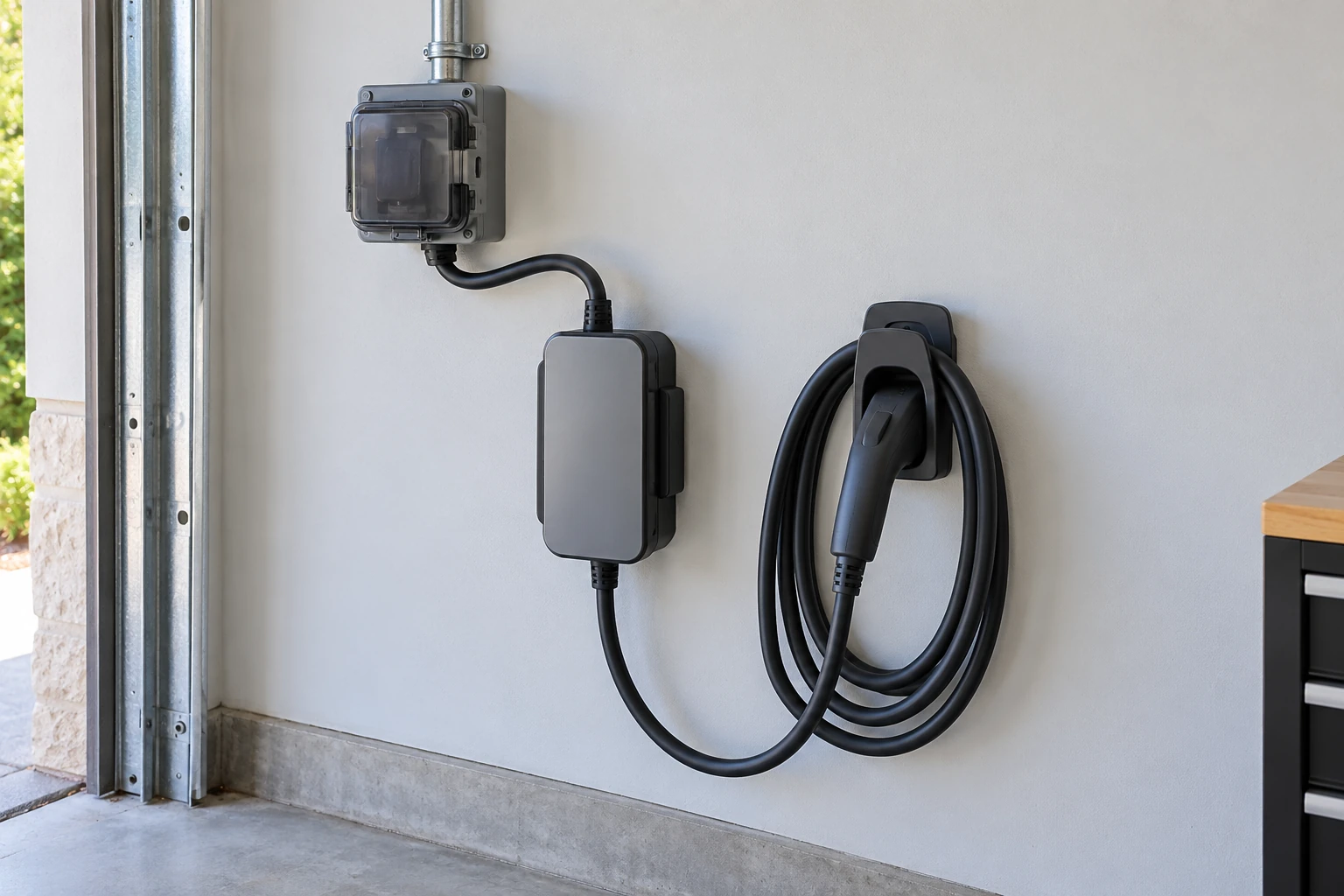
Do you need an outlet or a hardwired charger?
An outlet installation is appropriate when your charging equipment is designed to plug into that exact receptacle. A hardwired charger connects permanently to its electrical supply and does not need a plug-in outlet.
If you are still choosing equipment, ask the provider to compare both arrangements for the same parking position and daily charging needs. An outlet is useful for some portable cordsets. A hardwired unit may offer a better fit for other equipment, current settings or outdoor projects.
| Your situation | What to ask the provider |
|---|---|
| You own a portable EV charging cord | Which approved adapter and receptacle does this exact model require? |
| You own a plug-in wall charger | Is its plug configuration suitable, and what output is allowed in plug-in mode? |
| You own a Tesla Wall Connector | What does a hardwired installation require? |
| You have an unused dryer or welder outlet | Can this existing circuit and receptacle be used with the proposed equipment? |
| You have not bought a charger | How do outlet and hardwired designs compare for this space? |
For general equipment selection, see home EV charger installation in Buffalo. For a Wall Connector, see Tesla charger installation.
NEMA 14-50 outlet installation in Buffalo
NEMA 14-50 is a common receptacle configuration for compatible EV charging equipment. It is not a universal EV plug, and the outlet's rating does not tell you what a connected charger can deliver.
For example, Tesla's current Mobile Connector guidance specifies a maximum 32-amp output with its NEMA 14-50 adapter. ChargePoint's Home Flex guidance distinguishes NEMA 14-50 and NEMA 6-50 plug-in configurations from hardwired installation; the allowed output depends on the circuit and installation type.
Give the provider the equipment model and plug or adapter designation. If you bought a charger online, keep its manual available. Avoid ordering a receptacle installation based only on a product listing's headline amperage.
An EV-focused quote should specify the chosen receptacle, circuit rating, charger output and any protection required by the applicable rules. It should also name the actual receptacle hardware rather than leave you guessing which part is included.
Existing 240V outlet: assess it before charging
An existing outlet may reduce new work, but it needs an assessment for the planned charger. A plug fitting into the receptacle is only one requirement.
Ask the provider to check:
- Whether the outlet configuration matches the charging equipment's approved plug or adapter.
- The circuit's wiring, protective devices, grounding and condition.
- Whether another appliance uses that supply and what the proposed design permits.
- The receptacle's condition and suitability for the intended charging use.
- The charging output allowed for the complete installation.
- Whether the location lets the cord reach without an extension or obstructing access.
Tell the provider if the outlet has been unused for years or if you have noticed loose plug retention, discoloration, heat, a burning smell or repeated interruptions. Stop using visibly damaged or overheating charging equipment and arrange an assessment; a different adapter does not resolve an electrical condition problem.
You do not need to remove a receptacle cover, panel cover or charger enclosure before calling.
A dryer outlet is not automatically an EV outlet
Different dryer circuits and EV cordsets use different configurations and operating limits. The provider must check both the existing installation and the charging equipment instructions.
For the Home Flex models addressed in ChargePoint's installation FAQ, many dryer outlet types do not match the charger's NEMA 6-50 or 14-50 plug. A provider may consider a different approved design after assessing the circuit.
Do not assume a generic adapter or splitter makes an occupied dryer circuit suitable for simultaneous charging. If you want to retain the dryer on the same supply, describe that requirement before the quote. Any proposed sharing or management equipment needs a compatible, approved design.
Dedicated circuit and protection
The electrical scope includes more than mounting the receptacle. Ask how the provider will supply the charging equipment and meet applicable circuit and protection requirements. ChargePoint's installation manual, for example, calls for a dedicated circuit for its Home Flex equipment.
Ground-fault protection requirements depend on the installation and applicable code. The provider should resolve those requirements alongside the manufacturer's instructions. Required protection should not be removed to address nuisance tripping; ask whether an approved hardwired design would suit the equipment instead.
A new breaker also does not establish whole-home capacity. If the proposed circuit raises a capacity question, see our electrical panel assessment and upgrade page.
Garage, driveway and detached-garage outlets
Attached garage: choose a position that works with the charger's supply cord and the vehicle's charging cable. Let the provider know where shelving, doors and the other car will sit. Include mounting and cord storage in the scope.
Outdoor parking: the outlet, enclosure and charging equipment must suit the location. The Department of Energy's home charging guidance calls for outdoor-rated equipment for outdoor installations. Ask whether a hardwired charger would simplify the proposed arrangement.
Detached garage: tell the provider whether an existing feeder or subpanel supplies the building. That supply needs assessment, along with any new route, excavation and restoration. Price those items explicitly rather than treating them as an ordinary short garage circuit.
For any location, describe the actual parking position and cable path. The installation should work when the vehicle is parked normally, with doors open and people moving through the space.
What changes the installation price?
The main questions are the circuit route, available capacity, equipment requirements and location. A short accessible route near the panel differs from a route through finished rooms or out to a separate building.
Ask whether your written price includes the receptacle and enclosure, wiring or conduit, breaker and required protection, mounting, permits and inspection. Also confirm whether it includes the charger itself, charger setup and any finish repair. If existing wiring will be reused, the quote should identify the assessment and any limits on that assumption.
Our Buffalo installation cost guide explains budgeting for those configurations. A page-level estimate cannot establish the condition of an existing outlet or the route through your home.
Permits for EV outlet work
The City of Buffalo permit portal lists Repair and Electrical permits for EV car charger work. Have the provider confirm how the city classifies your outlet project and who will arrange the required inspection.
Suburban addresses follow their own authorities. State the municipality as well as the ZIP when you call, especially if the mailing address differs from the town or village where the property is located. Use the service area directory for local planning information and call to check availability.
EV outlet installation questions
Is a 240V outlet always cheaper than hardwiring?
No single rule answers that. The circuit route and capacity work may dominate either quote. Compare an outlet and hardwired design for the same vehicle, location and charging goal, with the same inclusions.
Can I get 48-amp charging from a NEMA 14-50 outlet?
Do not infer output from the receptacle name. ChargePoint's cited Home Flex models require hardwiring for 48-amp charging; Tesla's current Mobile Connector is limited to 32 amps with its 14-50 adapter. Have the provider apply your exact model's instructions.
Can you move an existing EV outlet?
Call to check whether relocation is supported for your address. The provider will need to assess the existing circuit and new location, including cable reach and any affected finishes.
Next step
Call about your charging outlet
Tell the provider whether you need a new 240V outlet, an existing-outlet assessment or help choosing between plug-in and hardwired charging. Add your town or ZIP, charger model and parking setup. That is enough to begin a useful scope conversation.
Read how the referral works before hiring an electrical provider.