
Commercial EV Charger Installation in Buffalo, NY
Choose charging for the vehicles that use your property and the time they actually park there.
An employee lot, hotel, retail property, and fleet yard have different charging needs. Start by defining the users, parking duration, initial number of charging ports, and future expansion. Call to check whether an accepting provider can assess your commercial EV charging project in Buffalo or a nearby community.
This is a demand-test pilot. No Buffalo-area installer is confirmed; calls currently ring the website operator and may go unanswered.
Updated October 14, 2026
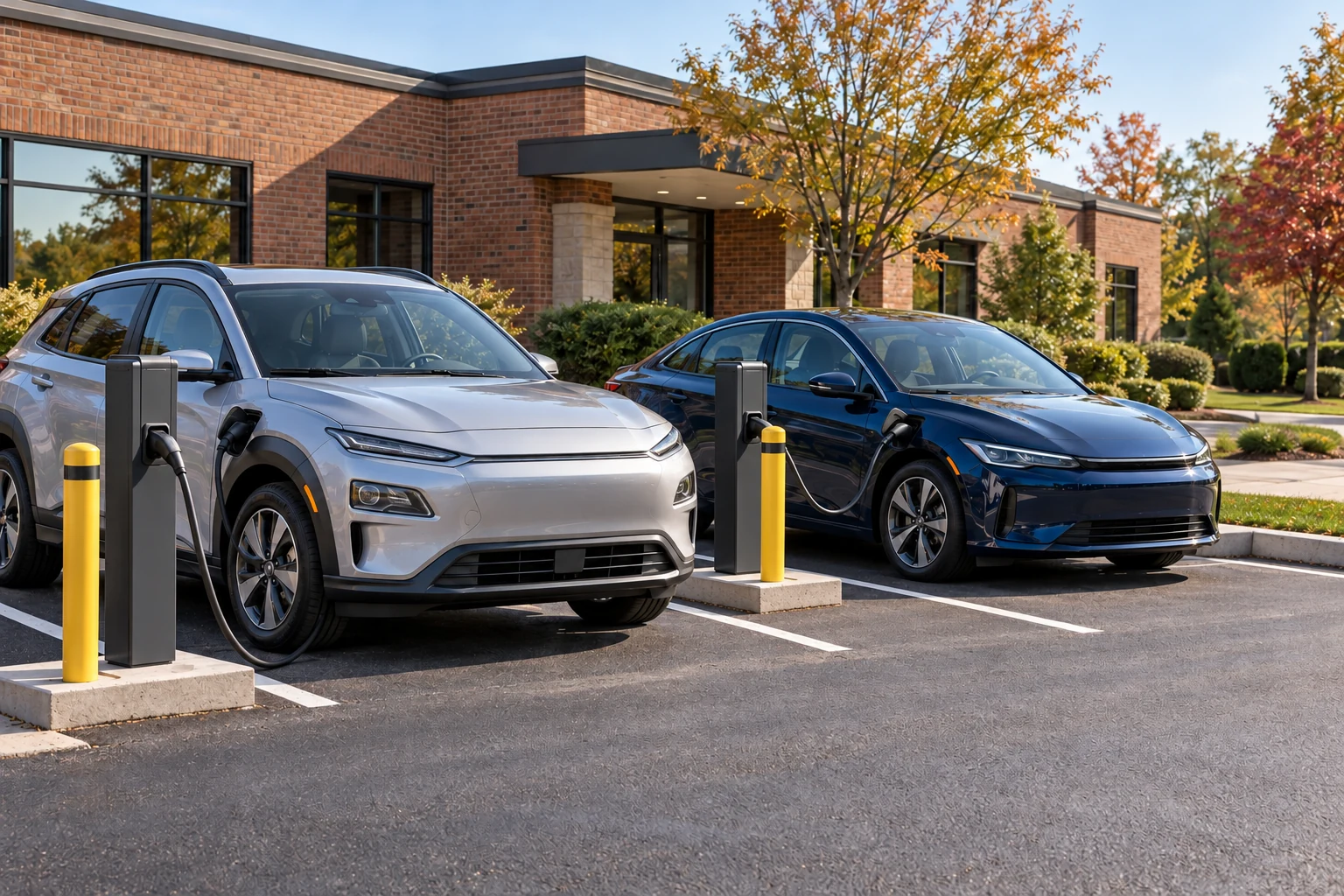
What kind of commercial charging are you planning?
Give the provider a clear operating goal before choosing equipment. “Install two chargers” leaves important questions unanswered: whether two vehicles can charge simultaneously, who can use the equipment, and how much energy each vehicle needs before leaving.
| Property or use | Start with this question | Quote should address |
|---|---|---|
| Office or employee parking | How long do vehicles remain parked during a shift? | Access rules, overnight versus daytime use, and employee demand |
| Hotel or destination property | Will guests charge for several hours or overnight? | Guest access, cable reach, usage policy, and staff responsibilities |
| Customer parking | How long does a typical visit last? | Whether the proposed charging level serves the visit and business goal |
| Light-duty fleet | How much energy is needed before each vehicle's next departure? | Vehicle schedule, simultaneous charging, and the available power budget |
| Mixed-use property | Are tenants, customers, and employees sharing the same spaces? | Separate permissions, parking rules, and billing responsibilities |
Apartment buildings and condo associations have additional resident and property-management decisions. Use our apartment and condo charging page for that scope.
Level 2 charging and DC fast charging are different projects
This page focuses on planning commercial Level 2 charging. DC fast charging requires a separate feasibility and equipment discussion; do not assume a provider accepting a workplace Level 2 project also builds fast charging sites.
The Department of Energy's charging equipment overview explains that charging performance depends on both the vehicle and equipment. A charger with two connectors also does not necessarily serve two vehicles simultaneously. Ask for the number of independently usable charging ports and the power available when all intended ports are occupied.
For a fleet, the departure schedule matters more than a maximum charging number in an equipment brochure. For a hotel, overnight access can matter more than short-session speed. Ask the provider to price the project around those needs.
Establish the first phase and the expansion plan
A useful scope separates what you are building now from what you want the site to support later.
For example, a hypothetical business might want two usable ports at opening and space for four additional ports after demand develops. The quote should state whether future pathways, spaces, electrical capacity, or controls are included. “EV ready” is too vague unless the proposal identifies what has actually been provided.
Ask for a written explanation of:
- Initial port count and configured charging power.
- Expected power per vehicle when several ports charge together.
- Parking spaces and equipment locations shown on a site plan.
- Existing electrical equipment proposed for reuse.
- Utility or service changes that must be confirmed.
- Conduit, trenching, pavement repair, and equipment protection in the scope.
- Future additions that can be made without repeating completed site work.
The DOE infrastructure planning checklist identifies utility coordination, siting, permits, inspections, networking, operating costs, and future needs as planning considerations. Your proposal should resolve the ones that apply to your site rather than burying them in exclusions.
Decide who owns and operates the chargers
The installation price is only part of a commercial charging decision. Clarify ownership of the hardware, responsibility for the network account, and who answers a driver's call when a charging session fails.
| Operating decision | Ask before signing |
|---|---|
| Access | Are chargers public, employee-only, guest-only, or controlled by a tenant? |
| Payment | Is charging free, billed by the operator, or handled through a network? |
| Account ownership | Can the property owner administer the equipment and retrieve its usage records? |
| Recurring charges | What software, connectivity, service, or transaction fees apply? |
| Maintenance | Who handles hardware faults, damaged cables, and network problems? |
| Exit terms | What happens to equipment operation and data if a service agreement ends? |
These are questions to put in your procurement brief. They are not claims that a particular charger or referral partner includes these features.
Put the electrical and civil work in the same budget
A parking-lot charger can require work beyond mounting a pedestal. The equipment location may affect cable routing, excavation, pavement restoration, access during construction, and protection from vehicles or snow-removal equipment.
Ask the provider to identify who handles each trade and who coordinates the schedule. Establish responsibility for any accessibility assessment and required design work. A property manager should also confirm who approves the parking layout and any changes to shared or leased areas.
A residential installation price is not a reliable budget for a multiport commercial site. Request a site-specific proposal with equipment, electrical work, civil work, permits, commissioning, and ongoing fees clearly separated.
Check utility program status before counting on funding
Program status checked October 14, 2026: National Grid's Upstate New York commercial programs page states that it stopped accepting Level 2 and DC fast charging Make-Ready applications on April 3, 2026. Older pages describing funding percentages should not be treated as an open offer for a new project.
Confirm the utility serving the actual property, any currently available program, and required approval before including an incentive in the budget. Ask for both the project price before incentives and any funding assumptions shown separately. Provider participation does not establish your project's eligibility.
Make the first call useful
Have the following ready: property town and ZIP code, your role and authority to approve work, the type of property, intended charging users, initial port count, parking duration, vehicle models if known, and target opening date.
If the project is only at the planning stage, say so. Ask whether the provider offers feasibility work, what it charges, and whether its scope includes design, utility coordination, civil work, or only electrical installation.
Frequently asked questions
Can a business start with just one or two charging ports?
That can be a practical first phase, but the provider still needs to assess the site and operating needs. Discuss expansion early so the initial layout does not block later equipment or create avoidable repeat construction.
Will every driver receive the charger's maximum power?
No. The vehicle's AC charging limit, the installed configuration, and any shared power allocation can limit the rate. Ask what power is available with all intended ports in use, rather than relying only on the equipment's highest advertised output.
Can charging fees pay for the project?
That requires a property-specific financial analysis. Utilization, pricing, electricity charges, network fees, maintenance, and installation costs all affect the result. This website does not promise charging revenue or a payback period.
Can I get commercial pricing from the home installation cost page?
Use it only to understand general cost drivers. Commercial equipment, multiple ports, civil work, operating fees, and utility requirements can produce a substantially different scope. Ask for a commercial site proposal.
Next step
Start with a defined project
Call to check commercial project availability. Describe your property's location, users, parking duration, and initial charging port count so an accepting provider can establish the next step.
We may receive compensation for a provider referral. The accepting provider is responsible for its proposal, qualifications, design responsibilities, installation, and warranties.