
Electrical Panel Upgrade in Buffalo, NY for EV Charging
Adding an EV charger does not automatically mean replacing your electrical panel. Start with a capacity assessment that considers your existing service, household loads, panel condition and the charging output you actually need.
Call to check availability for an EV-related panel assessment or upgrade. Tell the provider your town or ZIP, vehicle or charger model, and whether a previous quote recommended panel or service work.
This is a demand-test pilot. No Buffalo-area installer is confirmed; calls currently ring the website operator and may go unanswered.
Updated October 14, 2026
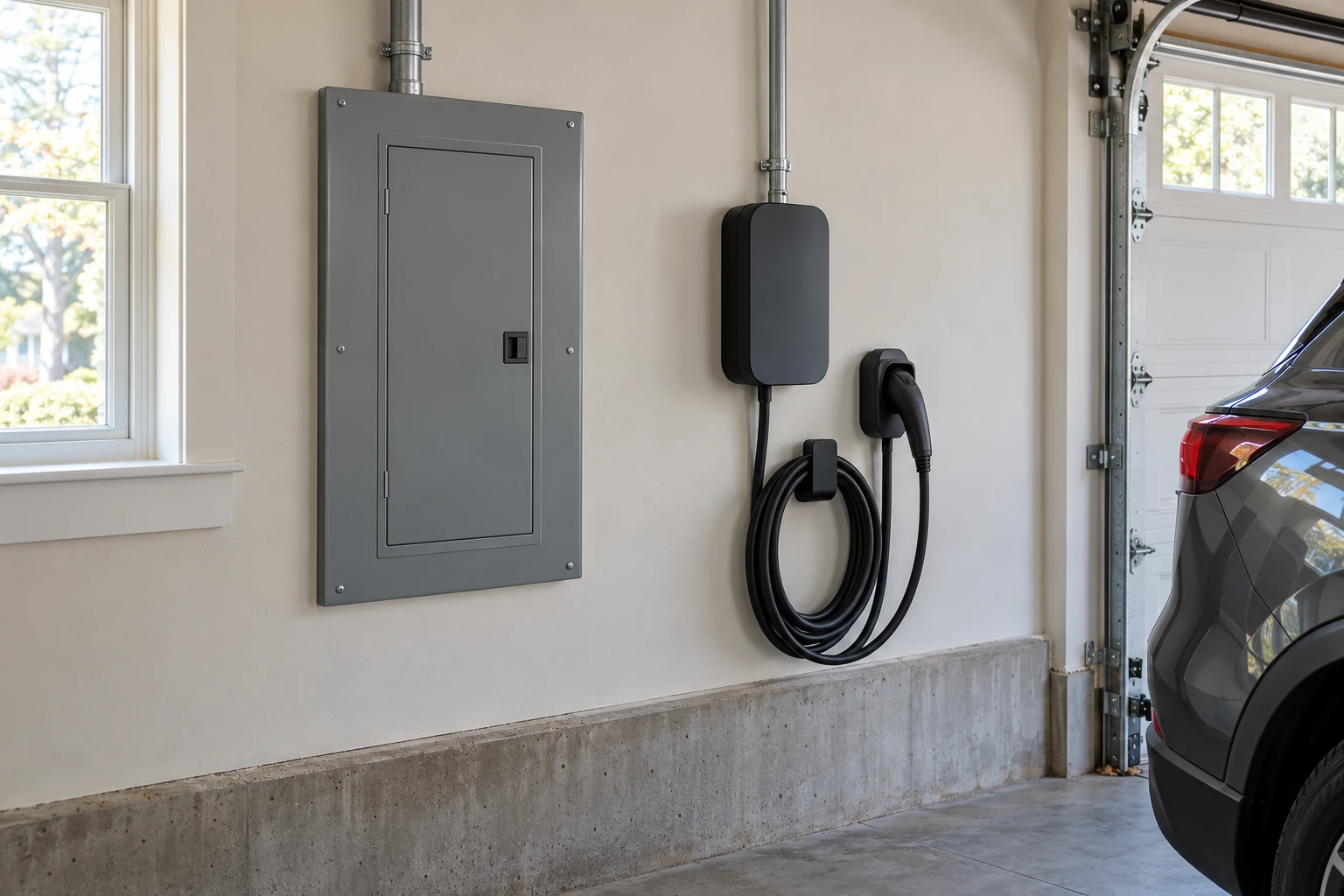
Do you need a panel upgrade for a home EV charger?
The assessment must answer two separate questions: is the electrical equipment suitable, and can the system support the proposed charging load?
A panel may have open breaker spaces without enough available capacity for the proposed charger. Another panel may be full but have capacity for an approved design that adds circuit space. A condition problem can require work even when charging demand is modest.
The Department of Energy's home charging guidance recommends having an electrician evaluate capacity. Give that evaluation a defined charging goal: your vehicle, daily driving, parking hours and equipment. A quote based on maximum charger output may differ from a design that meets your overnight charging needs at a lower setting.
What an EV capacity assessment should explain
Ask the provider to identify the constraint before recommending the solution.
| Assessment item | The question it should answer |
|---|---|
| Existing electrical service | What supply capacity is available to the home? |
| Household load calculation | How does the proposed charging demand fit with existing loads under the applicable rules? |
| Panel condition and compatibility | Is the equipment suitable for the proposed circuit and protective devices? |
| Breaker space | Is an approved circuit arrangement available? |
| Garage or outbuilding supply | Can any existing feeder and subpanel support this charging design? |
| Charger configuration | What output can be installed, and does it serve your driving needs? |
| Future work | How would a second EV, heat pump or other planned equipment affect the decision? |
There is no need to gather internal panel information yourself. If the visible labels are unclear, leave identification to the provider. Do not remove the panel cover or touch wiring to prepare for a call.
Panel replacement, subpanel and service upgrade are different
These terms should be separate in a written quote. Ask which work is proposed and what problem it addresses.
| Proposed work | What it does | What it does not establish by itself |
|---|---|---|
| Add a charging circuit | Supplies the EV charging equipment under an approved design | Whole-home capacity for that new load |
| Add a subpanel | Provides circuit distribution and additional breaker positions from an existing supply | Increased utility service capacity |
| Replace the main panel | Changes the home's distribution equipment, such as for condition or space requirements | That the utility supply has also been increased |
| Upgrade electrical service | Increases the supplied capacity through coordinated work on applicable service equipment | That every related construction or restoration item is included |
| Install compatible load management | Controls charging demand within the limits of an approved system | Repair of unsuitable or damaged equipment |
NYSERDA's panel guide distinguishes the main panel from subpanels and explains that service work can also involve the meter and service wiring. Ask your provider to name the equipment affected rather than put everything under a single “panel upgrade” line.
Can a 100-amp home support EV charging?
The service rating alone cannot settle the question. The home's other electrical loads, the chosen charging output and approved management options matter. A lower-output charging design may be workable in one 100-amp home and unsuitable in another.
The same applies to a 200-amp home: that rating does not automatically prove that any desired charger or two-car configuration will fit. Ask for the assessment supporting the proposed design.
If your provider recommends increasing service, ask what prevents the alternatives from meeting your needs. The useful answer might be an electrical condition, insufficient calculated capacity, the required charging performance or another planned home upgrade. Understanding the reason helps you compare the actual job.
Lower output and load management options
Fixed lower output: the charger is configured for an approved current level that suits the circuit and available capacity. Ask what that setting means for your daily charging, rather than comparing only the maximum number on the box.
Dynamic load management: a compatible system monitors electrical demand and adjusts charging within its approved limits. It may reduce charging while other large loads operate. Ask what happens if the monitoring or communication system is interrupted and how the installed design meets local requirements.
Management for multiple chargers: two cars introduce a different design question. Equipment that manages one charger against household demand is not automatically a system for distributing power across multiple chargers.
Manufacturer examples illustrate why model details matter. Schneider Electric describes managed charging that can avoid some service upgrades where accepted by the local authority. Tesla documents separate management features for its Wall Connectors. Ask the provider to specify the proposed model, extra hardware, configuration and approval basis.
A charging timer or a promise to avoid running appliances is not the same as a professionally designed load management system.
When an upgrade may be the right decision
Panel or service work may be appropriate when the proposed charging demand cannot fit an approved design, when equipment condition needs attention, or when a broader home upgrade makes additional capacity useful.
Tell the provider about planned appliances before the assessment. If you expect a second EV or heat-pump installation, ask for two clearly defined scopes: the work needed for today's charger and any optional work intended for future equipment. That makes the spending decision clearer.
Load management does not cure deterioration, damage or incompatible equipment. If you already have repeated unexplained breaker trips or visible damage, describe those conditions so the provider can assess them as part of the job rather than treating this only as a new charger circuit.
What should the upgrade quote include?
A useful quote connects each item to the assessment and separates charging work from other electrical work.
Ask for:
- The capacity or equipment issue that requires the proposed change.
- The exact panel, service or feeder work included.
- Any utility coordination, interruption of power and scheduling dependencies.
- The charger circuit, approved output and any management equipment.
- Required permits, inspection and who arranges them.
- Any new mounting, excavation, wall openings or equipment relocation.
- Finish repair and restoration inclusions or exclusions.
- Which items are required now and which are optional future provisions.
For a service upgrade, ask whether the quote is complete or depends on the utility's assessment. The provider should explain any costs or scope items that remain to be determined before you authorize the work.
See the Buffalo EV installation cost guide for budget planning. A price for a charging circuit should not be presented as the total for a panel replacement, service upgrade and charger package.
City of Buffalo permits and suburban projects
The City of Buffalo permit portal lists both Repair and Electrical permits for EV car charger work. The provider should confirm the requirements for the full project, including panel or service changes. Discuss inspection and utility coordination alongside the installation date.
Outside the city, the appropriate town, city or village may have its own process. Provide your actual installation address when calling. Our service area directory links local planning information; availability for panel and service work must be confirmed for that address and scope.
Questions about EV panel work
Will a garage subpanel let me add a charger?
It can provide distribution and circuit space, but its feeder and the home's capacity still need assessment. A subpanel rating is not extra power delivered from the utility.
Should I buy the charger before the assessment?
If capacity is uncertain, ask about the proposed charger first. Its configuration and management options can affect the electrical design. The provider can explain what equipment would work before you commit to a purchase.
Does the provider handle general panel upgrades without an EV?
This page focuses on panel and capacity work associated with EV charging. Call to check whether the accepting provider supports a separate general electrical project; that scope is not assumed by the website.
Next step
Call about capacity before committing to an upgrade
Have your town or ZIP, vehicle or charger model, and parking setup ready. Mention any written upgrade recommendation and future electrical equipment. Ask for the reason behind the proposed scope and whether a suitable lower-output or managed charging design is available.
Explore home charging installation, Tesla charger installation or EV outlet installation for the charging equipment side of the project.