
Home EV Charging Planner
Plan around the energy you need to replace and the hours your car is parked. You usually do not need to refill an empty battery every night.
The examples below turn daily miles into an energy estimate, then compare it with illustrative charging power. Use the result to explain your needs to an electrical provider. It does not select a breaker, wire, outlet, or safe installation setting.
This is a demand-test pilot. No Buffalo-area installer is confirmed; calls currently ring the website operator and may go unanswered.
Updated October 14, 2026
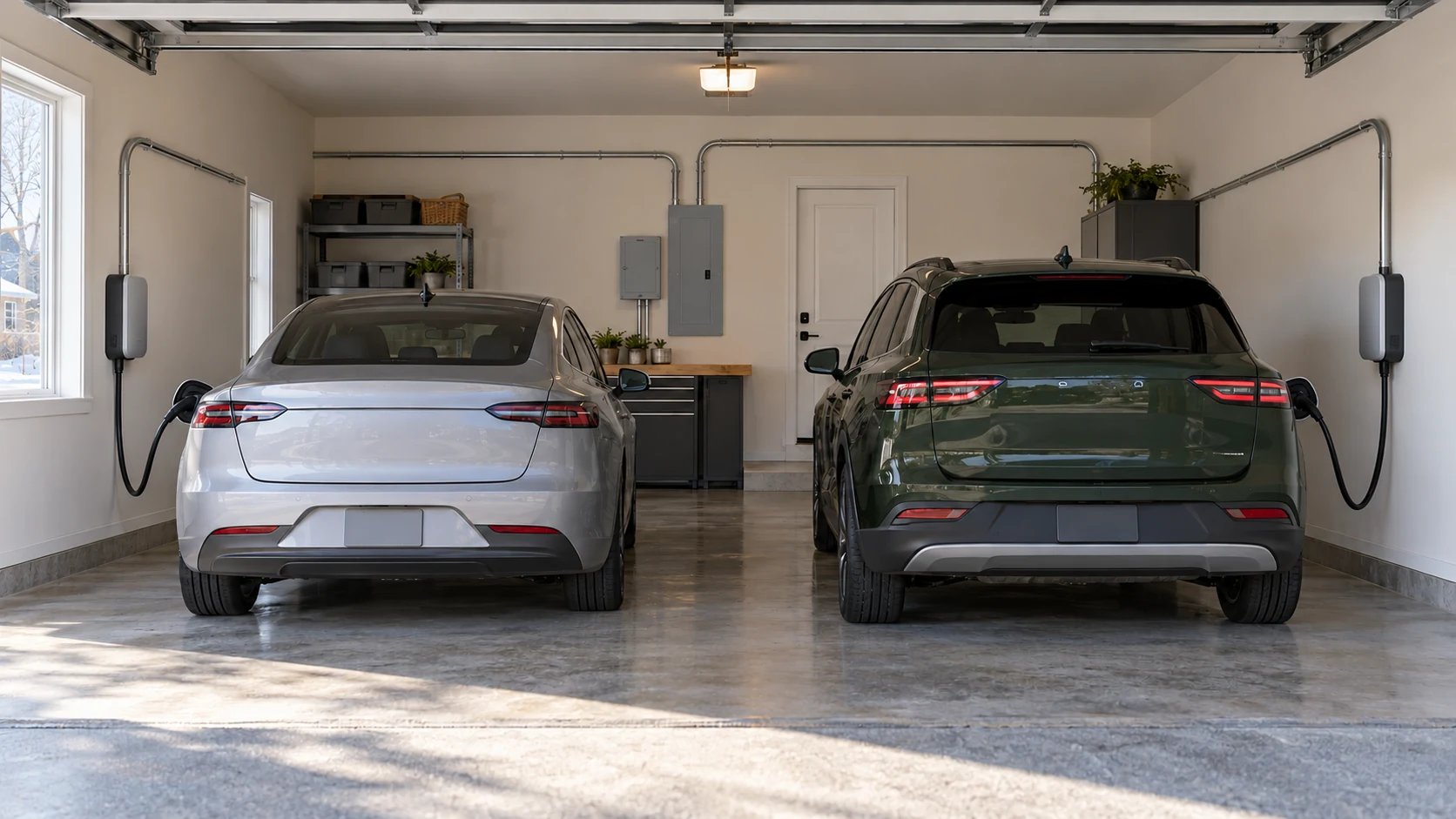
Start with four inputs
| Input | What to use | What it means |
|---|---|---|
| Daily miles | Typical miles you want home charging to replace | A normal day, a demanding day, or another clearly stated scenario |
| Battery energy per mile | A stated estimate in kWh per mile | Energy removed from the battery by driving, not necessarily energy measured at the wall |
| Charging window | Hours the car can actually remain plugged in | Account for departure, charging schedules, and any limited access |
| Usable charging power | Power supported by both the installed configuration and the vehicle | A planning assumption until the provider confirms it |
The DOE charging equipment overview identifies the vehicle's internal charger, equipment, electrical supply, and battery conditions as factors in charging time. A maximum number on a wall charger is only one part of the calculation.
If you do not know the vehicle's AC charging limit, check the manufacturer's information for the exact model and model year. Do not substitute the vehicle's advertised DC fast charging rate.
Try the charging planner
Open the home charging planner to change the hypothetical daily miles, energy use, parking hours, and charging output. Inputs stay in your browser; no contact information is required or submitted. Use the result to prepare questions for the provider, not to change electrical settings.
The calculation, with every assumption visible
Use these relationships when the driving estimate refers to battery energy:
- Battery energy to replace = daily miles × battery kWh per mile.
- Energy from the electrical supply = battery energy ÷ assumed charging efficiency.
- Illustrative AC power = voltage × charging current ÷ 1,000.
- Usable power = the lower of that AC power and the vehicle's AC charging limit.
- Estimated hours = supply energy ÷ usable power.
These are simplified energy and power calculations. They assume the stated power is sustained and the efficiency assumption holds. Actual charging can vary; managed charging, vehicle limits, and other conditions can lengthen the time.
Avoid counting charging losses twice. If your input already represents electricity drawn from the wall, use that supply-energy estimate directly. Do not divide it by a charging-efficiency factor again. A vehicle label or app figure needs to be understood before it is used as a battery-energy input.
Example: 35 miles per day
This is a hypothetical calculation, not a measurement of a particular car or Buffalo household.
| Assumption | Value |
|---|---|
| Driving to replenish | 35 miles per day |
| Battery energy used | 0.30 kWh per mile |
| Charging efficiency | 90%, chosen only to demonstrate the arithmetic |
| Supply voltage | 240 volts |
| Configured charging current | 32 amps |
| Vehicle AC limit | At least 7.68 kW for this example |
Battery energy to replace is 35 × 0.30 = 10.5 kWh. With the assumed efficiency, the electrical supply provides 10.5 ÷ 0.90 = 11.67 kWh.
The illustrative power is 240 × 32 ÷ 1,000 = 7.68 kW. The idealized replenishment time is 11.67 ÷ 7.68 = 1.52 hours at that sustained power.
That result describes replacing this day's driving energy. It does not promise a full charge in 1.52 hours. The provider still needs to confirm the equipment, vehicle, and installation configuration.
Compare charging currents for a 20 kWh supply-energy scenario
This table compares charging current delivered by an assumed configuration, not circuit breaker sizes. It assumes 240 volts, 18 kWh of battery energy to replace, 90% efficiency, and a vehicle able to accept the listed power. Supply energy is therefore 20 kWh in every row.
| Illustrative charging current | Calculated supply power | Idealized time to supply 20 kWh |
|---|---|---|
| 16 amps | 3.84 kW | 5.21 hours |
| 24 amps | 5.76 kW | 3.47 hours |
| 32 amps | 7.68 kW | 2.60 hours |
| 40 amps | 9.60 kW | 2.08 hours |
| 48 amps | 11.52 kW | 1.74 hours |
The table is arithmetic, not a list of universally available settings. Your charger may not support every row, your vehicle may accept less, and your electrical system may require a different configuration. An electrical provider chooses the permitted installation settings.
Test a more demanding day
Use a separate scenario instead of silently changing the assumptions. For example, keeping the 35-mile day but assuming 0.40 battery kWh per mile produces:
- Battery energy: 35 × 0.40 = 14 kWh.
- Supply energy at the same hypothetical 90% efficiency: 14 ÷ 0.90 = 15.56 kWh.
- Time at the same illustrative 7.68 kW: 15.56 ÷ 7.68 = 2.03 hours.
The 0.40 input is a sensitivity example, not a measured winter average. Use your vehicle's own driving data and realistic parking hours to create your scenario. Discuss whether it meets your daily needs and how you will handle occasional longer trips.
Planning for two EVs
Consider each vehicle separately, then add the energy required. Do not assume that two charging units double the power available from your home.
In a hypothetical household:
| Vehicle | Daily miles | Assumed battery kWh per mile | Battery energy to replace |
|---|---|---|---|
| Vehicle A | 35 | 0.30 | 10.5 kWh |
| Vehicle B | 50 | 0.35 | 17.5 kWh |
| Combined | — | — | 28.0 kWh |
At 90% assumed efficiency, combined supply energy is 28 ÷ 0.90 = 31.11 kWh. If the two vehicles can use an aggregate 7.68 kW continuously, the idealized total charging requirement is 31.11 ÷ 7.68 = 4.05 hours. That aggregate could be divided or scheduled in different ways; this example does not design the arrangement.
Ask the provider what each vehicle can receive when both are connected and whether the planned parking hours give both cars enough energy before departure.
Estimating electricity cost
For a simple energy-only estimate, multiply electricity drawn from the supply × an applicable price per kWh.
Using the first example for 30 identical driving days gives 11.67 kWh per day × 30 = approximately 350 kWh. At a hypothetical $0.20 per kWh, that equals $70. The rate is an example, not a Buffalo utility quote.
Use the variable supply and delivery charges that apply to added energy on your actual tariff. Dividing the entire bill by kWh can include fixed charges that do not increase with charging. Time-based rates also require the charging hours to be considered. The DOE's home charging guidance explains the relationship between vehicle efficiency, electricity prices, and charging costs; your utility bill supplies the local inputs.
Turn the calculation into a useful installation question
Tell the provider: “I need to replace about this much driving energy, the car is usually parked for this many hours, and I want to plan for this second vehicle or higher-use day.”
Then ask:
- What configured charging output can this property support?
- What AC charging rate can my exact vehicle use?
- Would a lower output meet my parking-time needs?
- If power is managed or shared, how should I estimate the usable charging window?
- What additional electrical work is needed, and why?
Compare the answer with the quote checklist and installation cost guide. Do not change charger settings or size electrical equipment from this planner.
About these examples
All scenarios, efficiency inputs, and electricity rates on this page are explicitly hypothetical. Results are rounded to two decimal places where useful; calculations use unrounded values. This is an original planning reference, not a test of charging equipment, a local electricity-price survey, or a promise of charge speed.
To cite it: Buffalo EV Charger Installation. “Home EV Charging Planner.” Updated October 14, 2026. Link to this page and preserve the assumptions when citing an example.
Next step
Ready to describe your charging needs?
Call with your town or ZIP code, vehicle and charger model, parking space, and usual time at home. Ask an accepting provider to confirm the installation options and quote scope for your property.
We may receive compensation for a provider referral. The accepting provider confirms the electrical assessment, configuration, price, and scheduling.